
Many applicants for German visas experience issues due to discrepancies in their travel photographs. Common errors include inconsistent background colours, inappropriate facial sizing, or inadequate illumination. Such errors can result in application delays or outright visa denial.
When applying for a German visa, meticulous adherence to the German embassy’s photographic specifications is paramount. To mitigate this risk, VisaFast offers the Germany Visa Photo Maker Tool. This tool incorporates automated adjustments to standardize your photograph and ensure compliance with all official requirements, thereby reducing the potential for application obstacles.
Within this document, we will provide instructions on utilising this tool and deliver a comprehensive overview of all specified image criteria pertinent to your German visa application process.
Germany Visa Photograph Specifications
The following outlines the official photograph requirements for obtaining a German visa:
- Dimensions: 35 x 45 millimeters
- File Type: JPEG/JPG – must be a high-quality print (either matte or glossy finish).
- Background: The photograph must have a plain background that is light in colour; either white or light grey is acceptable.
- Face Measurement: The face within the image must be between 32 and 36 millimeters in height (representing 70-80% of the total photo’s height).
- Border Requirement: The photograph must not have any borders or frame.
- Recency: The photograph must have been taken within 6 months .
- Orientation: The photograph must be a full-frontal view with your head centered.
- Quality Standards: Images must be sharp, well-lit, and free of shadows or red eye effects.
- Facial Expression: Maintain a neutral expression with your mouth closed and no smiling is permitted.
The VisaFast visa photo tool is designed to assure compliance with all stipulated photograph requirements.
German Visa Photograph Specifications
German visa photographs must conform to the following dimensions: 35mm in width and 45mm in height (1.38 x 1.77 inches or 3.5 cm x 4.5 cm). The face must occupy a horizontal area between 16mm and 20mm, measuring ear to ear.
For successful verification, the frontal face within the photograph should extend approximately 70% to 80% of the overall photographic area, encompassing the region from the base of the chin to the superior portion of the head (excluding hair).
Important: Applications with face measurements below 27mm or exceeding 40mm will be rejected.
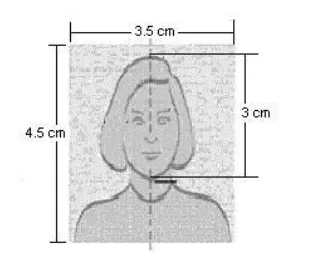
German Visa Photo Example
Photo Resolution Requirements
The German visa application requires photos with a resolution of 400 dpi. It is crucial to confirm this resolution setting during scanning or image uploading to ensure compliance. Note that increasing the resolution directly results in a larger image file size.
The photographic image must be in sharp focus, undamaged, and of high quality. It must be free from blemishes, creases, and any discernible ink marks.
Technical Requirements
For electronic applications for German visas, supporting images must be submitted in JPEG or JPG format. The file size for these images should not exceed 120 kilobytes (KB). Submissions in formats other than JPEG or JPG, including but not limited to BMP, TIFF, GIF, and PDF, are likely to lead to application denial. Colour photographs are acceptable.
Photograph Specifications
Applicants are required to submit photographs that meet specific criteria. The photograph must be printed on high-quality paper, ensuring a minimum resolution of 600 DPI. Color reproduction should demonstrate accurate color balance, with appropriate brightness and contrast and a natural skin tone representation.
The submitted photograph must depict only the individual applicant; no other individuals or objects may be included in the image.
Note: Digital camera photographs must be produced with a high level of detail, in color format and should ideally be printed on non-glossy photo-quality paper to ensure optimal image quality.
Photo Requirements
The passport photograph for a German visa application must feature a plain, light-colored background to ensure clear visibility of facial features and sufficient contrast.
Specifically, applicants with light hair should utilize a medium grey backdrop while those with dark hair should employ a light grey background. The background must be uniform, free from any patterns or shadows.
German visa photographs must be borderless, adhering to official formatting guidelines essential for biometric processing. Extra margins are not permissible.
Photograph Requirements:
All applicant photos must have been captured within the preceding six months. It is essential that the photograph accurately reflects your present appearance. Any recent and significant changes in appearance, including but not limited to a substantial change in hairstyle or alteration of facial hair, may necessitate the submission of a new photograph. Failure to comply with these requirements could result in delays to your German visa application and may lead to identification complications.
Photography Requirements
Images submitted as part of your application must utilize even lighting conditions; specifically, photographs should avoid significant shadows, reflections, or red-eye effects.
Applicants must ensure that the eyes within the photograph are fully open and unobstructed. Facial hair or any hair directly covering the eyes are unacceptable.
The eyes within the photograph are required to be positioned within the upper two-thirds of the image, with a minimum vertical distance indicator of 8 millimeters between the central points of the two eyes.
Expressions and Frame
You should show your face square on to the camera, no portrait style (not looking over ones shoulder) or tilted and showing both edges of face clearly. The facial expression must be neutral, mouth closed and looking directly at the camera.
Glasses:
Applicants requiring glasses due to a medical condition must present without any reflections and ensuring lenses are not tinted. Lens shapes and edges must avoid causing glare or obstruct the visible eye area; reflections may compromise biometric scanning accuracy and lens features should not obscure any portion of the eye.
Head Coverings
Head coverings are permitted solely for recognized religious or medical justifications. These coverings must be devoid of patterns and should not impede the clear visibility of the face. The entirety of the face, encompassing the area from the base of the chin to the browline, must be fully visible, with no shadowing permitted.
Germany Visa Photograph Specifications for Minors
- Photographs of infants under one year of age must feature open eyes.
- The submitted photograph must be of high quality and portray a frontal view of the child.
- For applicants aged under nine years, the child’s face should occupy approximately 50-80% of the total image.
- The measurement from the lower portion of the chin to the uppermost point of the head (excluding hair) should fall within the range of 22mm to 36mm.
- Children under the age of five are exempt from requiring a neutral expression or direct eye contact with the camera. Additionally, there is no requirement to center the child’s head within the photographic frame.
- The photograph should only display the child, and must not include any appendages, toys, chairs, or extraneous individuals.
- It is essential that the child’s face is fully visible and is oriented towards the camera.
Please note: If supplemental support is provided to the child in the photograph, this support should not be discernible within the image itself; the supporting hand can be concealed beneath the child’s clothing for compliance.
Guidance on Producing a German Visa-Compliant Photograph at Home
Applicants seeking a German visa can generate a suitable photograph utilizing the VisaFast Germany Visa Photo Maker Tool, without leaving their residence. The process functions as follows:
Photograph Acquisition: Options include uploading an existing photograph in JPEG, JPG, or PNG format, or capturing a new image directly using your smartphone or webcam.
Automated Adjustment: Upon uploading, select the “Transform” function. The tool will systematically modify the photograph to meet German visa regulations, specifically regarding background, dimensions, illumination, and orientation (alignment).
Image Retrieval: Following image processing, access and save the completed photograph for digital submission, or print as a physical copy to accompany your visa application.
With a photograph fulfilling German visa standards, your application process should proceed smoothly. VisaFast simplifies this critical task.
Do’s and Don’ts for German Visa Photos
Guidance for Photograph Requirements
- Employ illumination providing even light distribution without discernible shadows.
- Confirm the submitted photograph is current, adhering to the specified timeframe of 6 months.
- Maintain a neutral facial expression, ensuring the mouth is closed.
- Verify that the entirety of your shoulders and hair are clearly visible within the photograph.
- Utilize a plain white or light grey backdrop as the photographic background.
- Dark-colored head coverings are permissible solely for religious observance; however, the face must remain fully visible.
- When wearing spectacles, individual eye visibility must be maintained, avoiding any perceptible reflections within the lenses.
Don’ts
Don’t submit damaged or creased photos.
Don’t let hair cover your eyes or face.
Avoid red-eye, colored lenses, or tinted glasses.
Don’t wear sunglasses.
Don’t tilt your head; keep it straight and centered.
Can I take my Germany visa photo at home?
Yes, the VisaFast Germany Visa Photo Maker Tool is available for use. This tool automatically adjusts the photo’s background, size, and alignment, ensuring compliance with the specifications mandated by the German embassy.
Can I wear glasses in my Germany visa photo?
Yes, but only if the lenses are clear, with no glare or reflections, and your eyes are fully visible. Tinted or colored lenses are not allowed.
Are head coverings allowed in the photo?
Yes, but only in accordance with provisions regarding religious observance. Headgear is subject to restrictions concerning the avoidance of shadows and the visibility of the full face—from the forehead to the chin—to ensure unobstructed visibility for security purposes.
What are the most common mistakes to avoid?
Common mistakes include smiling, poor lighting, shadows, the wrong background, head tilting, and using old or damaged photos. The VisaFast photo tool helps avoid all of these.
What are the visa photo requirements for neighbouring Schengen countries?
Here are the visa photo requirements for neighbouring Schengen countries: