

Greece Visa for Indians
Greece Visa Information
Visa Type:
Sticker
Visa Type: StickerA visa sticker will be stamped on your passport.
Length of Stay:
90 days
Length of Stay: 90 daysYou can stay for a maximum of 90 days for any 180 day period.
If your visa is valid for less than 90 days, you can only stay upto your visa validity.
Validity:
Short-term
Validity: Short-termA Short term Schengen Visa allows temporary entry into the Schengen Area for tourism.
Entry:
Multiple
Entry: MultipleYou can enter the country more than once during the validity of your visa.
Method:
Visa Appointment
Method: Visa AppointmentApply at your nearby Visa Appointment center.
Greece Visa Rejection Reasons
Factors that can get your visa rejected
Expired Passport
Applying with a passport that has expired or expires within 6 months
Insufficient Funds
Failing to demonstrate enough financial resources to support your stay.
Criminal Record
Having a criminal history that disqualifies you from obtaining a visa.
Previous Visa Violations
Having overstayed or violated the terms of a previous visa.
Invalid or Insufficient Travel Insurance
Failing to present valid or adequate travel insurance
Frequently Asked Questions
Do Indians need a visa for Greece?
Yes, Indian passport holders require a valid visa, namely a Schengen visa (type-c), to enter Greece for temporary purposes, including tourism, business activities, family visits, or other permitted activities, for a maximum duration of 90 days days within a period of 180 days. Greece does not provide visa-on-arrival or visa-free entry privileges to Indian nationals.
What is the Greece visa fees for Indians?
The Greece visa fees for Indian applicants are as follows: €90 for Adults, €45 for Children (aged 6 to 12 years), and no charge for Children under 6 years. Important: Visa fees are subject to change based on exchange rate variations or supplementary charges levied by the visa application centres.
Guidance: Applicants are advised to retain the precise visa fee amount at the time of their appointment, as payment options are determined by the specific visa application centre.
What is the Greece tourist visa validity for Indians?
The Greece tourist visa, issued to Indian applicants, provides validity for a maximum of 180 days. This allows for a maximum stay of 90 days within that timeframe.
Important Consideration: The specific visa type—whether it is single-entry or multiple-entry—determines the number of permitted entries and exits to the Schengen Area. A multiple-entry visa facilitates multiple arrivals and departures during the visa’s overall validity period.
Can I travel to other Schengen Countries with a Greece visa?
Yes, a Greece visa allows you to travel freely to other Schengen Countries without needing additional visas. However, when applying, you should clearly state your intention to visit multiple Schengen Countries and provide a detailed itinerary covering your entire trip.
Tip: Make sure your first point of entry is Greece or that Greece is your main destination, as this will align with the requirements of the Greece Embassy where you are applying for the visa.
My Schengen visa is from France, but I’m travelling to Greece. Is that okay?
Yes, it is possible to enter and travel to Greece utilizing a Schengen visa initially issued by France. However, it is crucial to adhere to the following stipulations:
Point of Entry: We recommend entering Greece via France, given that your visa was issued by that country. Specifically, France should serve as your primary entry point within the Schengen Area. Following your entry into France, you may subsequently travel to Greece or other Schengen nations.
Primary Destination for Your Stay: You should allocate the substantial majority of your stay to France, as this is where you are obligated to apply for your visa.
If these guidelines are not applicable? Please refer to our guide on Obtaining a Schengen Visa From One Country and Traveling to Another? (Essential Legal Guidance) to gain a comprehensive understanding of how to manage such circumstances effectively and maintain compliance with Schengen requirements.
What is the difference between a single-entry and a multiple-entry Schengen visa?
Single-entry Schengen visa allows you to enter the Schengen Area only once. After leaving, you cannot re-enter, even if the visa is still valid.
Multiple-entry visa, on the other hand, allows you to enter and exit the Schengen Area multiple times within the visa’s validity period (as long as you do not exceed the 90-day stay limit within 180 days).
Can I apply for a multiple-entry Schengen visa for Greece?
Yes, you can apply for a multiple-entry Schengen visa for Greece. Multiple-entry visas are typically issued for 1, 3, or 5 years, depending on your travel history and the discretion of the consular officer.
Note: Despite having a multiple-entry visa, you can only stay for a maximum of 90 days within a 180-day period.
What is the 90/180 rule for Schengen visas?
The 90/180 rule is a crucial guideline for travellers holding a Schengen visa, dictating how long they can stay within the Schengen Area. It states that you can stay for up to 90 days within any 180-day period in the Schengen Area. These 90 days can be consecutive or spread across multiple trips. However, the cumulative stay within the Schengen Area must not exceed 90 days in any rolling 180-day window.
Understanding the rule:
Rolling period: The 180 days are counted on a rolling basis, meaning each day you are in the Schengen Area, the 180-day period shifts forward by one day. For instance, if you stay from January 1 to March 31, you can return on May 1 but must leave by July 30 (the next 90-day window).
Multiple entries: The rule applies regardless of whether you are on a single-entry or multiple-entry visa. If you leave the Schengen Area and re-enter, the days spent inside are still counted towards your 90-day limit.
Tracking your days: It’s important to keep track of the number of days you’ve spent in the Schengen Area during the last 180 days. Overstaying can result in fines, deportation, or a ban from re-entering the Schengen Area in the future.
Example:
If you enter the Schengen Area on January 1 and stay for 30 days, you have 60 more days to use within the next 150 days.
If you leave and return after 60 days, say on April 1, you can stay for another 60 days, completing your 90 days within that rolling 180-day period.
Note: You must not overstay. If you exceed the 90-day limit, you may face penalties, including fines, deportation, or a ban on re-entering the Schengen Area. Each country within the Schengen Zone may handle overstays differently, but the consequences are generally severe.
Have there been any recent changes in the Schengen visa process for Indian citizens?
Recent modifications to the Schengen visa process for Indian citizens encompass:
Digitized Application: A greater emphasis on the digitalization of the application procedure, enabling applicants to complete forms and upload specified documents electronically.
Biometric Requirements: Biometric data, including fingerprints and a digital photograph, is now mandated for all applicants, excluding those who have previously provided this data within the last 59 months.
Cascade Regime: Per the European Union’s “cascade” system, Indian nationals are eligible to transition from a two-year visa to a five-year visa, affording comparable travel privileges to visa-free nationals, provided all stipulated conditions are satisfied.
Fee Adjustment: The visa application fee for Schengen visas has been adjusted to €90 from €80 for adult applicants.
Should you have upcoming travel plans to the Schengen Area, it is essential to remain informed of the most current visa regulations and directives by consistently monitoring the official website for updates.
What is Schengen visa shopping?
Schengen visa shopping refers to the practice of applying for a Schengen visa through a country that is perceived to have a more lenient or faster visa approval process rather than applying through the country that is your primary destination. This is generally frowned upon by Schengen authorities and can result in visa rejection or complications during your travel.
Consequences of visa shopping:
Rejection: Visa applications can be rejected if the consulate suspects that you are not genuinely planning to visit the country through which you applied.
Entry issues: Even if you receive a visa, you may face issues when entering the Schengen Area if immigration officials believe your main destination is not the country that issued your visa.
Record: Schengen authorities share information, and previous visa shopping attempts may affect future applications.
Tip: Always apply for a Schengen visa through the country where you plan to spend the most time or the country that is your first point of entry in the Schengen Area.
How to check available appointment dates for a Greece visa for Indians?
The VisaFast Schengen visa appointment tracker allows you to check the available appointment dates for the Greece Schengen visa easily without logging in.
What are the Greece visa requirements for Indian citizens?
Greece Tourist Visa Requirements for Indian Applicants:
The following documentation is typically required for the issuance of a Greece tourist visa:
A completed visa application form.
A recent passport-sized photograph.
A valid passport, ensuring it meets all Greece visa entry requirements.
Documentation demonstrating the purpose of your travel to Greece.
Supporting evidence of your travel arrangements.
Evidence of confirmed accommodation bookings.
Financial statements or other documentation verifying your ability to cover your expenses during your stay in Greece.
Proof of comprehensive travel insurance meeting the minimum coverage requirements for Greece.
Application Form for a Greek Visa:
The Greece visa application must be submitted on a form that is fully executed and bears the applicant’s signature.
Passport Photograph:
A current, passport-sized photograph complying with Greek visa regulations, as detailed at Greece’s specific visa photo requirements (e.g., a background must be entirely white and the image must not be more than 6 months days old).
Utilizing VisaFast, applicants can submit a passport-sized photograph and simultaneously capture an image with their smartphone or computer camera. VisaFast automatically processes the uploaded image to ensure compliance with Greek requirements, eliminating manual adjustments.
Valid Passport Requirements:
A valid passport or travel document is required that remains valid for a minimum of 3 months days beyond the expiration date of your Schengen visa application. The passport must have been issued within the past 10 years and must contain a sufficient number of blank pages, typically at least two. Applicants are also required to submit copies of any previous passports held.
Utilizing the VisaFast platform allows you to upload passport photographs, and simultaneously capture an image of your passport using a smartphone or computer camera.
Proof of travel purpose:
Provide a clear and concise cover letter outlining your personal information, purpose of visit, financial means and intent to return.
VisaFast will help you with a customizable cover letter during the application process, free of cost.
Travel Documentation:
You must present evidence of return tickets and documentation confirming a reservation with an intra-Schengen airline, as well as train schedules or vehicle rental confirmations if your itinerary involves travel across multiple Schengen states.
Flight reservations through VisaFast are available at no cost, enabling you to demonstrate your travel intentions without incurring financial obligations.
Accommodation Verification:
Please provide documentation confirming your intended accommodation arrangements for the duration of your stay in Greece. Should you be invited, you must present a notarised invitation letter from the inviting individual, obtained in Greece. This letter must be notarized to ensure its validity.
VisaFast facilitates accommodation arrangements by offering complimentary hotel reservations, thereby illustrating your travel itinerary without necessitating upfront financial investment.
Proof of financial means:
The government needs proof of your capability to fund your stay. For this, you will need to submit bank account statements for the last three months (preferably showing a minimum balance of €3000, ITR acknowledgement for the last two years, payslips for the last 3 months, employer contract and employer’s statement on approval of holidays.
Travel Insurance Requirements:
Applicants must maintain travel insurance coverage valid for all Schengen countries. The policy must provide a minimum coverage of €30,000, or its equivalent, for all risks throughout the complete duration of the intended trip.
Important Information: Additional documentation may be necessary based on the details provided within the visa application. This may include a sponsorship letter if the trip is financially supported by a sponsor.
What documents are required for minors applying for a Greece tourist visa?
Minors seeking a Greece visa are subject to specific documentation requirements.
Should a minor be traveling solely with one parent or guardian, written consent, notarized by a public notary, from the remaining parent or legal guardian is mandatory, unless sole custody or guardianship has been established.
If the minor is traveling unaccompanied (without parents or legal guardians), written consent, also notarized, from both parents or guardians exercising custody or guardianship is necessary.
Certified copies of the parents’ passports must be submitted. Alternatively, if unavailable, the applicant’s birth certificate and copies of the parents’ identification documents should be provided.
Even if one parent possesses a valid visa, a notarized consent letter from that parent remains a required document.
Note: Applicants are advised to bring both original documents and certified copies to their visa appointment.
Can I apply for a Greece tourist visa without a confirmed flight booking?
Yes, an application for a Greece tourist visa can be submitted even without a pre-booked flight. Supporting documentation requires submission of a flight itinerary or reservation.
VisaFast offers verifiable flight reservations at no cost, enabling applicants to demonstrate their travel intentions without incurring any financial obligations.
Can I apply for a Greece Schengen visa if my accommodation is not confirmed?
Yes, you can apply for a Greece Schengen visa without confirmed accommodation, but you still need to show proof of where you plan to stay. This can include temporary hotel bookings or an invitation letter from friends or family who will be hosting you.
The consulate requires this to ensure that you have arrangements in place for your stay. Even if your plans are not finalised, providing a reservation or written confirmation of your accommodation will satisfy this requirement during the visa application process.
VisaFast provides verifiable hotel reservations for free, allowing you to demonstrate your travel plans without any financial commitment.
Is travel insurance mandatory for a Greece tourist visa?
Yes, travel insurance is a mandatory requirement for applications seeking a Greece tourist visa. Furthermore, the required travel insurance must fulfill the following specifications:
A minimum coverage amount of €30,000.00 is required.
The insurance policy must be valid across the entirety of the Schengen European Union.
Coverage must extend for the complete duration of the applicant’s intended stay or transit within the Schengen Schengen Area.
The travel insurance must include protection for expenses incurred due to repatriation for medical reasons, urgent medical assistance, emergency hospital care, or death that may occur during the stay(s) within Member States.
For applicants holding multiple-entry visas, it is essential to confirm that your travel insurance policy covers your initial trip. Subsequent trips can then be insured with renewed coverage.
Important Note: Please acquire travel insurance through certified insurance providers listed on the Greece Visa Application Centre’s website: approved travel insurance companies
Several insurance providers, such as VisaFast, offer policies meeting visa requirements at a competitive price, covering Schengen eligibility criteria.
What are the Greece visa photo requirements for Indians?
It is essential that your photograph complies with the Greece visa photo requirements detailed below:
Recency: The photograph must not be older than 6 months.
Dimensions: 1.2 x 1.6 inches.
Head Size: The head should constitute 70-80% of the total image area.
Background: The photograph must be in color and feature a uniform white or light grey background.
Facial Position: The applicant’s face must be centrally positioned and directly facing the camera, presenting a neutral expression.
Eye Visibility: Both eyes must be fully open and clearly visible, without any reflections or obstructions.
Spectacles: If wearing spectacles, ensure the lenses are free of glare or reflections and that your eyes remain clearly visible. Avoid the use of tinted lenses.
Headwear: Head coverings are prohibited unless for recognized religious reasons. If headwear is worn, the face must be fully visible from the base of the chin to the top of the forehead, and the edges of the face must be clearly discernible.
Important Note: Strict adherence to these photographic specifications is required; any deviation may result in processing delays or visa rejection.
What is the minimum bank balance required for a Greece tourist visa for Indians?
While Greece does not mandate a specific minimum bank balance, applicants must demonstrate sufficient funds to cover the duration of their intended stay in the Schengen Area. A recommended guideline suggests maintaining an average daily balance of approximately €60-€70, which equates to roughly €1,800 to €2,100 for a 30-day visit.
Financial stability can be evidenced through submission of recent bank statements and pay stubs. Should an applicant be receiving sponsorship, the sponsoring entity must furnish a sponsorship letter alongside comprehensive financial documentation to substantiate their ability to support the applicant’s stay.
Note: Maintaining a consistent bank balance over a six-month period prior to application submission may positively influence the review process. Unexplained fluctuations or significant deposits may necessitate further scrutiny.
What can I do if my bank balance fluctuates significantly?
To mitigate potential concerns regarding fluctuations in your bank balance, applicants should furnish supplementary information to the visa officer.
Offer Justifications: When significant deposits or withdrawals occur, a concise explanation should be included within your Greece application cover letter. Specifically, document the source of any large deposits, such as proceeds from a property transaction or annual compensation payments.
Present Supplementary Evidence: Submit supporting financial records, including details of fixed deposits, mutual fund holdings, or property ownership documentation, to demonstrate a stable financial profile.
Maintain Account Stability: Where feasible, strive to maintain a consistent account balance during the period preceding your application to reflect a demonstrable level of financial stability.
Important Note: Provide comprehensive and accurate financial documentation to prevent potential scrutiny and associated delays in the processing of your visa application.
Can I show multiple sources of income to strengthen my visa application?
Yes, submitting multiple income sources can positively impact your visa application. This may encompass:
Employment Income: Present verifiable documentation, such as recent salary statements and bank records demonstrating consistent earnings derived from your employment.
Passive Income: Provide evidence of income generated from investments, rental properties, or other passive revenue streams.
Sponsorship Support: Should a third party be providing financial support for your trip, include their relevant financial documentation and a formal sponsorship letter.
Note: A detailed and explicit enumeration of all income sources within your application cover letter is recommended to comprehensively illustrate your financial capacity.
Are income tax returns mandatory for a Greece tourist visa application?
Yes, submission of income tax returns (ITR) for the preceding two calendar years is typically required when applying for a Greece visa. These ITR documents serve to substantiate your financial resources and demonstrate your capacity to support your expenses while residing in Greece.
Note: In the event that ITR documentation cannot be provided, a comprehensive justification must be submitted via cover letter. Supporting documentation demonstrating alternative evidence of income or financial stability should also be included.
What should I do if I haven’t filed income tax returns for the past two years?
If you have not submitted income tax returns (ITRs) for the preceding two years, this could potentially impact your visa application. To mitigate this, consider the following actions:
Prepare a detailed explanation: Submit a letter outlining the circumstances that led to the non-filing of ITRs. Acceptable justifications may include recent employment, income levels below the taxable limit, or status as a dependent.
Present supplementary financial evidence: Include alternative documentation demonstrating your income and financial standing, such as bank statements, pay slips, or investment records.
Submit sponsor’s ITR: When a sponsor is supporting your trip, provide their ITR documentation accompanied by a formal sponsorship letter to further substantiate your application.
I am a housewife with no independent income. What are the documents I can submit to get my Greece visa approved?
As a homemaker without independent income, you must furnish the following documentation to substantiate your Greece visa application:
Sponsorship Letter: Acquire a sponsorship letter from your spouse or a close family member outlining their commitment to finance your trip. This letter must explicitly detail the familial connection and their assurance of financial coverage.
Sponsor’s Financial Records: Submit your sponsor’s bank statements, income tax returns, and salary slips to demonstrate their financial capacity to support your travel expenses.
Proof of Relationship: Provide a copy of the relevant document – such as a marriage certificate – validating the relationship between you and your sponsor.
Evidence of Shared Assets: If applicable, present documentation reflecting jointly held property or bank accounts, reinforcing your combined financial standing.
Note: Ensure all supporting sponsorship materials are presented in a structured and organized manner, clearly illustrating the anticipated financial support required throughout your trip.
How can a businessman succeed in obtaining a Greece tourist visa?
To improve your Greece visa application as a business applicant, it’s crucial to present compelling evidence of financial stability and clearly articulate the objective of your business travel. Here’s a breakdown of the required documentation:
Business Financial Records: Submit comprehensive financial statements for your business, including profit and loss statements, balance sheets, and bank statements, spanning a minimum of six months.
Company Documentation: Provide copies of essential business registration documents, such as your Goods and Services Tax (GST) certificate, Company PAN card, and incorporation certificate.
Business Tax Returns: Include copies of your business’s income tax returns for the preceding two years to substantiate financial health and demonstrate sustained operational stability.
Official Invitation: If travelling for business purposes, a formal invitation letter from your Greek business partner or the organization you intend to visit is required. This letter must detail the nature of your business activities and the anticipated duration of your stay.
Note: Within your cover letter, explicitly connect your business operations with the specific objectives of your visit to reinforce the legitimacy and purpose of your trip.
I am unemployed. Can I still get a Greece tourist visa?
Yes, a Greece visa is obtainable even without current employment. To supplement standard documentation like bank statements and Income Tax Returns (ITRs), applicants are required to furnish evidence demonstrating sufficient funds to cover expenses during their intended stay. Acceptable supplementary documentation may comprise:
Evidence of Passive Income: Submit documentation confirming regular income derived from sources like rental agreements, dividend statements, or interest income generated through investments.
Assets Documentation: If relevant, provide documentation pertaining to ownership of assets which produce passive income, including property deeds or investment certificates.
Note: A comprehensive explanation of the source and nature of your passive income should be included in your cover letter, and all submitted financial documents must align with these explanations.
How can a retired individual succeed in applying for a Greece tourist visa?
To increase your chances of success with a Greece visa application if you are retired, you must demonstrate sufficient funds and a well-defined purpose for your visit. The following documentation is typically required:
Pension Documentation: Submit comprehensive pension statements covering the preceding six months, serving as evidence of a consistent and reliable income source.
Bank Statements: Provide bank statements reflecting a substantial and regular pension income, alongside demonstrable pension credit activity.
Financial Asset Verification: Include supporting documentation detailing savings accounts, fixed deposits, mutual fund holdings, or property ownership—all of which contribute to your established financial stability.
Retirement Verification: Present a certified copy of your official retirement certificate or a formal letter from your former employer, explicitly confirming your retirement status.
Travel and Accommodation Details: Detail your planned travel itinerary and specific accommodation arrangements within Greece, ensuring they are clearly articulated.
Sponsorship Confirmation (if applicable): If a family member is providing financial support, submit a sponsorship letter accompanied by verifiable evidence of their financial capacity to cover your stay.
How can I show strong ties to India when applying for a Greece Schengen visa?
To substantiate your intention to return to India, applicants must present compelling evidence of strong ties to their home country. Supporting documentation includes, but is not limited to:
Proof of Employment: Individuals employed at the time of application should submit a formal letter from their employer, detailing their position, salary, and confirmation of approved leave, explicitly stating that their employment will be maintained upon your return.
Property Ownership: Submission of documents verifying ownership of property or real estate located within India, encompassing residential properties or land holdings, is required. This requirement extends to all applicants, irrespective of their employment status (e.g., retirees, homemakers, or those currently unemployed), as demonstrable property ownership serves as a significant indicator of established roots within India.
Family Ties: Evidence of family connections should be provided through the presentation of marriage certificates or birth certificates pertaining to dependent children. This documentation is particularly pertinent for applicants who are homemakers or unemployed, as it highlights familial responsibilities and reinforces the intention to return home.
Educational Commitments: Students should submit a letter from their educational institution confirming enrollment and specifying the anticipated date of return to resume their studies.
Note: The volume and strength of evidence demonstrating ties to India will positively influence the assessment of your application.
How can I prove the purpose of my trip when applying for a Greece Schengen visa?
You can prove the purpose of your trip by providing the following documents:
Tourism: Hotel reservations, a detailed travel itinerary, and return flight tickets.
Business: An invitation letter from a company or business partner in the Schengen Area, along with details of meetings or conferences you plan to attend.
Family visit: An invitation letter from your host in the Schengen Country, along with their proof of residence and relationship to you.
Tip: Be as specific as possible in your cover letter, detailing the activities and plans during your stay to strengthen your application.
Do I need a cover letter for my Greece Schengen visa?
Yes, a cover letter is typically required for a Schengen visa application. It should include:
Personal information: Your name, address, and passport number.
Purpose of visit: Detailed explanation of why you’re visiting (tourism, business, family visit).
Itinerary: Your travel dates, accommodation, and places you plan to visit.
Financial means: State how you’ll finance your trip and attach supporting documents.
Intent to return: Explain your ties to your home country, ensuring you’ll return after your trip.
VisaFast will help you with a customizable cover letter during the application process, free of cost.
I’ll be staying with a friend in Greece. Do I need an invitation letter?
Yes, if you’re staying with a friend in the Schengen Area, you will need an invitation letter from them.
A Schengen invitation letter is a document provided by someone you plan to visit in the Schengen Area, stating that they invite you and will accommodate you during your stay. The letter should typically include:
Your friend’s information: Name, address, and a copy of their passport or residency permit.
Accommodation details: Confirmation that they will host you during your stay.
Relationship: A brief explanation of your relationship with the host and the purpose of your visit.
What should I do if my passport is set to expire soon, but I need to apply for a Greece visa?
If your passport is set to expire soon, it is advisable to renew it before applying for a Greece visa. Your passport must be valid for at least three months beyond the expiry of your Schengen visa.
What if I only have one empty page left in my passport, but my passport has not expired?
If your passport contains only one unused page, it may be sufficient for visa issuance. Nevertheless, destination immigration officials may necessitate additional blank spaces for entry and exit stamp application.
It is recommended that you renew your passport if you have a limited number of blank pages remaining. An Indian passport renewal utilizing the ‘Tatkal’ (express) service generally requires approximately 3 days.
Can I apply for a Greece Schengen visa if I have overstayed on a previous visa?
Yes, you can apply for a Greece Schengen visa if you have overstayed on a previous visa, but you must be prepared to explain the circumstances of the overstay and provide evidence that it was unintentional or unavoidable.
Tip: A clear and honest explanation, along with supporting documents (such as medical records if the overstay was due to health reasons), can help mitigate the negative impact of a previous overstay.
How do I get a multiple-entry Greece Schengen visa?
To obtain a multiple-entry Greece Schengen visa, particularly under the new rules favourable for Indian citizens, follow these steps:
Establish a travel history: First, obtain and lawfully use two Schengen visas within the previous three years.
Apply for a multiple-entry visa: After meeting the above condition, apply for a multiple-entry visa, which can be valid for up to two years initially. If you use this visa correctly, you can then apply for a five-year multiple-entry visa.
Ensure passport validity: Ensure your passport has sufficient validity to cover the entire duration of the multiple-entry visa you seek.
Provide strong justifications: Your application should include reasons for needing multiple entries, such as frequent business trips, family visits, or ongoing travel requirements.
Use the Cascade Regime: The Visa Code Regulation (EC) No 810/2009 governs the issuance of Schengen visas. Under the EU’s “cascade” regime, Indian citizens can progress from a two-year visa to a five-year visa, enjoying travel rights similar to visa-free nationals if all conditions are met.
For more detailed guidance, visit the European External Action Service.
What are the chances of getting a long-term Greece visa for Indians?
The chances of obtaining a long-term Greece Schengen visa (valid for up to 5 years) depend on several factors, including:
Previous travel history: A positive history of compliance with Schengen visa rules, including timely departures.
Strong justification: A well-documented need for frequent travel to Greece or other Schengen Countries, such as for business or family reasons.
Complete and accurate application: A thoroughly completed application with all necessary documents and no discrepancies.
Note: While exact approval rates for long-term visas are not publicly available, applicants with a strong travel history and clear reasons for multiple visits have a higher likelihood of approval.
How to apply for a Greece visa from India?
Here’s how you can apply for a Greek tourist visa from India:
1. Required Documentation:
Initially, compile all necessary documentation, including a valid passport, the most recent three months’ bank statements, payslips, income tax returns, and any other documents specified within the outlined requirements.
2. Accessing VisaFast:
To proceed, access the VisaFast platform via the VisaFast website or the mobile application. Specify Greece as your intended destination within the system.
3. Schedule Your Appointment:
Complete the required information, submit the necessary supporting documentation, and remit the designated appointment fee. Upon successful completion, you will receive a confirmation pertaining to your visa appointment date.
4. Submitting Your Application Materials:
Please proceed to the designated visa application center on your appointed date. VisaFast will facilitate the submission of your documents in the specified sequence. As part of the process, you will be required to undergo biometric data collection, including fingerprint and facial scans.
5. Payment of VisaFast Fee and Service Charges:
The VisaFast Fee must be paid, and processing will commence, encompassing travel insurance and courier service charges.
6. Receive Your Visa:
Once approved, your passport with a Greek tourist visa stamp will be delivered directly to your home.
Tip: Begin your visa application process at least 6-8 weeks before your planned travel date to account for processing time and any unforeseen delays.
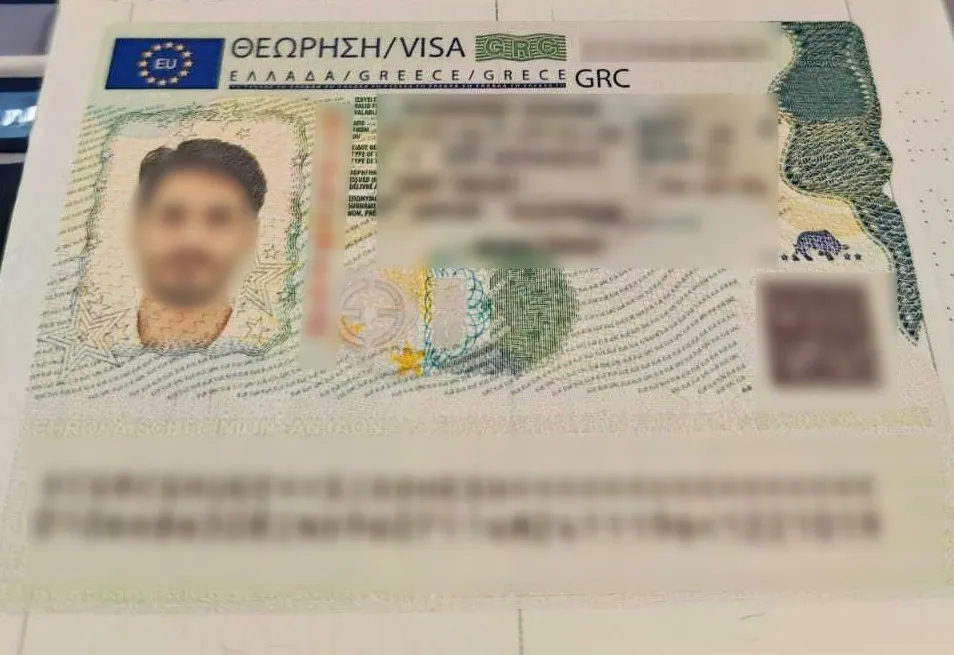
How does the Greece Schengen visa look like?
Here is a sample of the Greek tourist visa:
Do I need to submit my passport for Greece tourist visa processing?
Yes, submission of your passport is necessary for processing a Greek tourist visa application. Your passport serves as documentation for identity confirmation, verification of your travel background, and the subsequent application of the visa sticker upon approval.
Upon a determination regarding your visa application, you may retrieve your passport from the visa application center or receive it through a courier service should you select this option.
Is an interview mandatory when applying for a Greece-Schengen visa?
No, a consular interview is generally not required to obtain a visa for Greece. Nevertheless, the visa officer may request an interview under specific conditions. These include instances where there are inconsistencies within your application, or when the officer determines a further evaluation is warranted.
What will be the process on the day of my Greece tourist visa appointment?
On the day of your Greece tourist visa appointment, the following steps will be taken:
Document Presentation: You will present all required supporting documents, encompassing your passport, recent photographs, and bank statements, alongside the completed visa application form.
Fee Payment: Payment of the Greece visa fee is necessary, and a receipt must be retained for your reference.
Biometric Capture: Biometric data, specifically fingerprints and a digital photograph, will be collected unless this data has already been submitted within the last 59 months.
Important: To ensure efficient processing, please verify that all submitted documents are complete and properly organized.
Can someone collect the passport from the Greece Visa Application Centre on my behalf?
Yes, if you cannot collect the passport in person, you may authorise another person to collect it on your behalf.
The authorised person will need to bring the following documents at the time of passport collection:
Original payment receipt of the applicant(s);
An original signed and certified authorisation letter from the applicant;
A photocopy of the applicant’s ID;
Original and a photocopy of the ID proof of the authorised person.
Can I expedite the processing of my Greece Schengen visa application?
No, an expedited processing service does not exist for Schengen visas. Applicants should submit their applications with sufficient lead time and meticulously verify that all required documentation is included and correctly presented to minimize the potential for processing delays.
Can I include multiple family members in one Schengen visa application?
No, each family member must submit a separate Schengen visa application, including children and infants. Each applicant must meet the requirements and provide their own set of documents.
Tip: When applying as a family, submit all applications together to ensure they are processed simultaneously and to streamline the appointment process.
What is the Greece visa processing time for Indians?
The Greece Visa processing duration for Indian applicants generally requires 15 business days when submitted through the Greece Visa Application Centre (GVAC) located in Delhi.
Should your application be lodged via a GVAC outside of Delhi, the processing timeframe will be increased by an additional 5 days. This increase reflects the time necessitated for the transfer of the application to the Embassy in Delhi for completion of the final processing stages.
Important: Processing times may be extended due to requests for supplementary documentation or the need for consular interviews, or during periods of high application volume. To mitigate potential delays, applicants are advised to submit their applications at least 4-6 weeks prior to their anticipated travel date, accompanied by fully completed and accurate supporting documentation.
How can I check the status of my Greece tourist visa application online?
To monitor the progress of your Greece visa application, you can utilize the VisaFast Greece visa status tracking tool.
Can I work on a Greece tourist visa?
Important Notice: It is strictly prohibited to engage in any employment activities, including remote work, while holding a Greece tourist visa. This visa category is exclusively for tourism, recreational travel, or brief visits and does not authorize any work-related activities.
Potential Outcomes: Any instance of unauthorized employment will result in serious consequences, including potential deportation and permanent bans from obtaining future visas.
Recommendation: Should you intend to pursue employment during your travels in Greece or within the Schengen Area, you must obtain a visa specifically designed for this purpose. Examples include a digital nomad visa, if available and fulfilling the relevant eligibility criteria.
What happens if I lose my passport with a Greece visa while travelling?
If you experience the loss of your passport while holding a Greece visa, it is imperative to promptly file a report with the local police authorities and secure a formal police record of the incident. Subsequently, you must visit the closest Indian embassy or consulate to initiate the process of obtaining an emergency passport. Furthermore, you should explore the potential for the reissue of your visa, subject to applicable regulations.
To streamline the replacement process, we advise maintaining secure photocopies of your passport, visa, and other critical documentation, stored separately from the original documents.
My travel dates have been postponed. Is my Greece visa still valid?
If your Greece visa is approved but your travel dates have changed, you can still use the visa as long as the new travel dates fall within the visa’s validity period. However, if your new travel dates are outside the visa’s validity, you will need to apply for a new visa.
Tip: When booking flights and accommodations, ensure they align with the visa’s validity period to avoid complications.
Can I bring prescription medication into Greece on a Schengen visa?
Yes, it is permissible to import prescription medications into Greece while holding a Schengen visa. However, travelers must present original prescriptions or a formal letter from a physician. These documents should clearly detail the traveler’s information, the specific medication, dosage instructions, intended usage, and the quantity authorized, all of which must be issued on official letterhead.
Can I bring my pet to Greece with a Schengen visa?
Yes, it is possible to travel to Greece with your pet utilizing a Schengen visa; however, several conditions must be satisfied.
Microchip Implantation: Your animal companion must be fitted with a microchip conforming to the ISO 11784/11785 standard, which incorporates a 15-digit pet identification code.
Rabies Vaccination: A valid rabies vaccination is mandatory for your pet, and the immunization must be administered at least 21 days prior to commencing travel.
Veterinary Health Certificate: For travel originating outside of the European Union, a veterinary certificate issued by a recognized official in the third country is required.
Tapeworm Treatment: Dogs are subject to a mandatory tapeworm treatment administered 24 to 120 hours before entry into Greece.
Note: It is crucial to verify the precise pet importation regulations for Greece and the Schengen region in advance of your journey to guarantee adherence to all applicable requirements.
What can I do to ensure my Greece visa application is approved?
As of 2023, the rejection rate for Indians applying for a Greece Schengen visa at the consulate was 28.4%, compared to 34.7% in 2022. Although there has been a decrease in the rejection rate, it is still higher, meaning that nearly one in three Greece visa applications could be denied.
Hence, it is important to take the following precautions to ensure a successful Greece visa application.
Complete and correct documentation: Ensure all required documents are accurate, complete, and meet the specified Greece visa requirements. Always be truthful and transparent in your application. Any inconsistencies or false information can lead to immediate rejection.
Clear purpose of visit: Ambiguities in your travel purpose, itinerary, or reasons for visiting can lead to rejection. Ensure that you provide a believable and coherent travel plan that aligns with your stated purpose of visit. Your travel itinerary should align with the flight tickets and hotel reservations.
Sufficient financial proof: Clearly demonstrate that you have sufficient funds to cover your stay in Greece and other Schengen States if visiting.
Valid travel insurance: Obtain comprehensive travel insurance that meets the mandatory coverage requirements.
Strong proof of ties to India: Failure to prove strong ties to India could indicate a risk of overstaying. You must provide strong evidence, such as an employment letter, property deed or family ties, that clearly shows the authorities that you will not overstay.
Tip: For a better and more detailed understanding, read our comprehensive blog on the most common Schengen visa rejection reasons and how to avoid them.
Will I get a refund if my Schengen visa application is rejected?
No, the Greece Schengen visa fee is non-refundable, even if your visa application is rejected.
What can I do if my Greece visa application is rejected?
If your Greece tourist visa application is unsuccessful, you have two available courses of action:
Reapplication: You may reapply following the identification and rectification of the reasons contributing to the initial rejection, confirming the completeness and accuracy of all submitted documentation.
Appeal: Alternatively, you may lodge an appeal against the decision within 30 days days of the rejection date. To effect this, collect any outstanding documents or information and compose a formal appeal letter articulating the grounds upon which your visa application should be approved.
For comprehensive information regarding the visa reapplication and appeal process, please consult our detailed guide on Schengen Visa Re-Application.