

Canada Visa for Indians
Canada Visa Information
Visa Type:
Sticker
Visa Type: StickerA visa sticker will be stamped on your passport.
Length of Stay:
180 days
Length of Stay: 180 daysThe maximum duration that you are allowed to remain in a country after entering with that particular visa.
Validity:
10 years
Validity: 10 yearsThe number of days your visa is active after the date of issuance. We ensure your visa is valid based on your travel dates.
Entry:
Multiple
Entry: MultipleYou can enter the country more than once during the validity of your visa.
Method:
Visa Appointment
Method: Visa AppointmentApply at your nearby Visa Appointment center.
Canada Visa Rejection Reasons
Factors that can get your visa rejected
Expired Passport
Applying with a passport that has expired or expires within 6 months
Insufficient Funds
Failing to demonstrate enough financial resources to support your stay.
Criminal Record
Having a criminal history that disqualifies you from obtaining a visa.
Previous Visa Violations
Having overstayed or violated the terms of a previous visa.
Frequently Asked Questions
Do Indians need a visa for Canada?
Yes, individuals of Indian nationality require a valid visa for entry into Canada. Applications for a Canada visitor visa are available for temporary visits intended for tourism, recreational activities, or social engagements. These visas authorize stays of up to 6 months.
How long does it take to process the Canadian tourist visa?
The Canada visa processing timeframe typically ranges from 5-6 weeks. It’s important to recognize that this duration is subject to fluctuation based on several considerations. Key factors impacting processing times include the volume of applications being processed, the intricacy of your application details, and the occurrence of public holidays. Additionally, the presence of prior criminal convictions or documented instances of previous visa violations may necessitate additional processing time.
How long can I stay in Canada with a tourist visa?
A Canadian tourist visa allows you to stay in Canada for up to 6 months per visit. However, the Canadian border services officer will determine the exact duration of your stay when you arrive. The officer will stamp your passport, indicating how long you can stay. If they do not specify a date, you are allowed to stay for the full 6 months.
What are the types of Canada visas for Indians?
There are several visa categories available to Indian applicants seeking entry to Canada. These include:
Visitor Visa: This visa enables entry into Canada for purposes including visiting family and friends, conducting business activities, or for leisure travel.
Transit Visa: Individuals transiting through Canadian airports for layovers lasting less than 48 hours require a transit visa. If the layover exceeds 48 hours, a visit visa is necessary.
Work Permit Visa: Indian nationals desiring to engage in paid employment within Canada should apply for a work permit visa.
Student Visa: Indian citizens intending to pursue long-term studies at a designated learning institution within Canada are eligible to apply for a student visa.
What is the Canada visa fees for Indians?
The cost of a Canadian visa for Indian applicants is ₹11,753 which covers multiple entries (excluding applicable service charges). The visa’s validity period extends to 10 years, allowing for a maximum stay of 180 days.
What are the eligibility requirements for obtaining a Canada visa?
To qualify for a Canada visitor visa, applicants must meet the following requirements:
- A valid passport, demonstrating validity for the complete duration of the proposed stay in Canada, is required.
- There must be no prior criminal record or history of immigration-related offenses.
- Applicants must demonstrate substantial connections to their country of residence, including documented family relationships or employment obligations.
- Sufficient financial resources must be available to cover all expenses during the intended visit to Canada.
- Applicants are required to furnish demonstrable evidence of their intention to return to India upon completion of their authorized stay.
What are the Canada visa requirements for Indians?
Here is the list of documents required to apply for a Canada visa from India:
Passport (current and previous): Please provide scanned copies of the front and back pages of your passport, including all visas and stamps. Your passport must be valid for the entire duration of your intended stay in Canada. Additionally, submit copies of any previous passports you may possess.
Previous visas: Submit copies of any previously held USA or Canada visas, if applicable.
Photograph: You will need to submit a recent passport-sized photograph (35 x 45 mm) with a plain white background, adhering to the Canada visa photo requirements.
Identity verification: You must submit copies of your Aadhar card for identity verification purposes.
Family Information Form: All applicants aged 18 years or older are required to download and complete the Family Information Form (IMM5645).
Travel documentation: Provide supporting documents outlining your travel plans, such as flight itineraries and hotel reservations.
Financial documentation: Submit bank statements covering the last 6 months, 3 months pay slips, and the most recent 3 years’ ITR to demonstrate sufficient funds to cover your expenses during your stay in Canada. You may also include documentation related to fixed deposits, mutual funds, equity investments, or other assets, if applicable.
Employment documentation: Submit relevant employment records. If employed, provide an offer letter, a No Objection Certificate (NOC) from your employer, the last 3 months’ salary slips, and the most recent 6 months’ bank statement of your salary account (if applicable). For self-employed individuals, submit the most recent 3 months ITR.
Note: Additional documentation may be required based on the specifics of your visa application. For instance, a marriage certificate is necessary if you are currently married.
Is there a specific bank balance requirement for a Canada tourist visa?
The Canadian visa application process does not explicitly state a minimum bank balance requirement. However, applicants must demonstrate they possess adequate financial resources to support their intended stay.
This includes covering costs associated with accommodation, meals, transport, and other personal expenditures. The precise sum needed is variable, influenced by elements like the length of your visit, the size of your travel party, and the planned nature of your activities.
Do I need travel insurance when applying for a Canada visa?
Important Note: Travel insurance is not mandated for Canadian visa applications. However, obtaining travel insurance is strongly advised for international travel. Such insurance provides coverage for potential risks including lost or delayed baggage, unforeseen trip cancellations, and medical emergencies.
Recommendation: Prior to purchasing travel insurance, carefully examine the policy details to ascertain the specific coverage provided.
What should I do if I have a criminal record and want to apply for a Canada visa?
If you have a criminal record, entry into Canada may still be possible, contingent upon the nature of the offense, its age, and your conduct since the offense occurred. Potential avenues include:
Deemed Rehabilitation: If sufficient time has elapsed since your conviction, you may be considered rehabilitated and therefore not inadmissible to enter.
Individual Rehabilitation Application: You may apply for rehabilitation if you can demonstrate a low risk of re-offending. This option is generally available where at least five years have passed since the completion of your sentence.
Record Suspension: Possession of a record suspension (pardon) from Canada or another country may result in inadmissibility being waived.
Temporary Resident Permit Application: If you do not qualify for rehabilitation, you may apply for a Temporary Resident Permit to gain entry, notwithstanding your criminal record.
Note: It is advisable to initiate the rehabilitation process well in advance, as applications for rehabilitation can take upwards of one year to process.
How will I receive my Canada visa?
After your Canadian visa is approved, you will need to retrieve it from the designated visa application centre. The visa will be affixed to your passport as a physical sticker. A sample of a Canadian visitor visa is shown below:
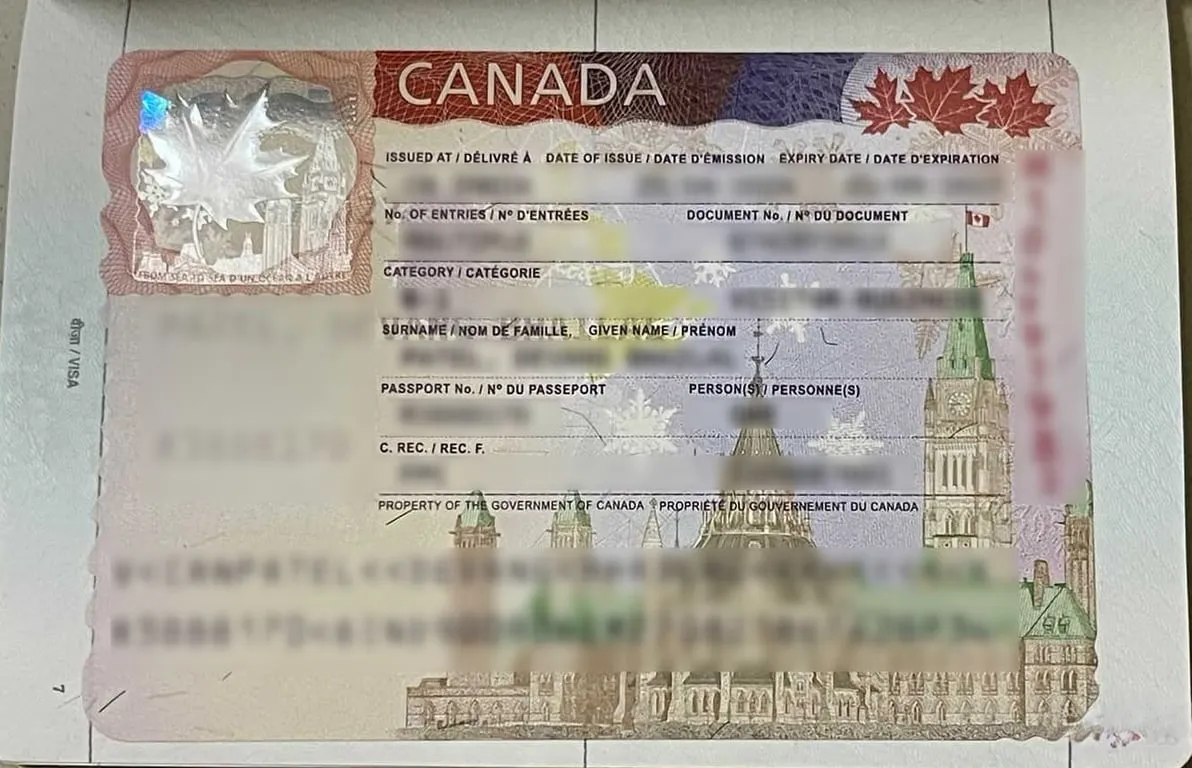
Important Note: Upon receiving your visa, carefully verify all information, including your name, passport number, and the visa’s expiration dates, to prevent potential complications during border crossings.
Do I need to attend an interview when applying for a Canada visa?
No, an interview is not required when applying for a Canadian visa. However, Canadian authorities may request an interview to obtain further clarification regarding your application.
During a potential interview, visa officers will typically inquire about the following:
Purpose of Travel to Canada: Visa officers will seek to understand the rationale behind your visit, including whether it is for tourism, business, or to visit family, to confirm the suitability of the visa type and to fully assess your travel plans.
Employment Status: Your current employment situation will be evaluated to determine your ability to financially support your stay in Canada, as well as to gauge your stability and existing connections within India.
Connections to India: You should anticipate questions concerning your family, property, or any investments held in India. These factors are assessed to demonstrate your strong ties to India and your intention to return to India following your visit.
Prior Visa History: Officers will likely ask about any previous visa applications or travel history to determine your compliance with Canadian immigration regulations.
Criminal Record Information: Applicants will be required to disclose any criminal history to ensure they meet the necessary criteria for obtaining a Canadian visa and to assess any potential security risks.
Please be aware that you must still visit the designated application centre to submit your visa application and provide the necessary biometric information.
What is biometrics, and do I need to provide it for my Canada visa?
Yes, you must submit your biometric information at the visa application centre. Biometric information involves collecting and analysing personal physical traits, such as fingerprints and facial features. This process helps verify your identity and ensures your visa application is secure.
Your biometrics are also taken upon entry to verify that your approved visa matches your identity.
How do I apply for my Canada visa through VisaFast?
To apply for a Canadian visa as an Indian citizen, utilizing VisaFast involves the following procedures:
Access VisaFast: Initiate the process by accessing the VisaFast website or mobile application, specifically selecting the visa category suitable for Indian applicants seeking entry to Canada.
Document Upload: Applicants are required to upload necessary documentation, including their passport, passport-sized photographs, and all other mandated visa-related documents, directly from their personal devices.
Fee Payment: Applicants must adhere to the provided payment instructions to finalize the remittance of the designated visa fee.
Biometric Appointment Scheduling: VisaFast will facilitate the scheduling of your visa biometric appointment, securing the earliest available time slot and communicating your confirmed appointment details.
Biometric Submission: On your scheduled appointment date, please present yourself at the visa application centre (VAC) to submit your biometric data (fingerprints and photograph) and furnish any supplementary documentation as may be requested.
Visa Processing: Following the completion of your biometric appointment, the Canadian government will undertake the review and processing of your visa application.
Visa Collection: Upon visa approval, applicants have the option to either receive their visa and passport delivered to their residential address or to collect them directly from the visa application centre.
Why choose VisaFast?
Accommodate Multiple Travelers: The VisaFast platform facilitates the inclusion of co-travelers, including friends and family, within a single visa application. This functionality simplifies the application procedure, reducing the time and effort required when applying for multiple visas concurrently.
Streamlined Application Process: VisaFast’s intuitive platform enables you to commence the Canada visa application with a minimal number of straightforward steps.
Accelerated Appointment Scheduling: Obtaining a Canada visa appointment can be a protracted process. However, through VisaFast’s expert service, you will be provided with an accelerated visa appointment date.
Efficient Visa Processing: VisaFast guarantees the timely processing and delivery of your visa. We operate with efficiency to satisfy your travel deadlines, enabling you to concentrate on trip planning rather than visa delays.
Customized Visa Support: VisaFast offers personalized guidance aligned with your particular visa requirements. Regardless of whether you require a tourist, business, or family visa, the platform adapts the application process to precisely meet your distinct needs, guaranteeing the submission of appropriate documents and pertinent information for a successful application.
Can I convert my visitor visa to a work visa in Canada?
No, it is generally not possible to transition a visit visa into a work visa in Canada. Nevertheless, an application for a Canadian work permit can be submitted concurrently with a visit visa application.
To be eligible for a work permit application while holding a visit visa, the following conditions must be satisfied:
- A valid visitor visa is mandatory at the time of the application.
- A job offer supported by a Labour Market Impact Assessment (LMIA) or a LMIA-exempt employment offer is necessary.
- The application must be lodged prior to February 28, 2025.
- The applicant must fulfill all standard admissibility requirements.
Can I work or study in Canada with a tourist visa?
No, a Canadian visitor visa is limited to short-term visits solely for purposes like tourism, familial visits, or business meetings. To engage in employment or academic pursuits within Canada, you must apply for a suitable visa category, including a work permit or study permit. Any employment or academic activity undertaken while holding a visitor visa constitutes a violation of visa conditions and may lead to consequences such as deportation or a permanent ban from entering Canada.
My travel date to Canada has been postponed. Will my issued visa still be valid?
Yes, you are typically permitted to travel to Canada, given the standard validity of the Canadian visa. It is crucial to verify the “date of expiry” associated with your visa. Provided your planned travel dates do not precede this expiry date, your existing visa remains valid for entry into Canada.
The “date of expiry” denotes the final permitted entry date into Canada; it does not represent the total allowed duration of your stay. Should your intended travel dates extend beyond this validity period, a new visa application is necessary.
Can Indians extend their visa application?
Yes, Indian citizens are eligible to request an extension of their visitor visas. An extension of stay will be processed through the submission of a visitor record application, which must be completed online via the official Canadian government website. Applicants will require a scanner to generate digital copies of supporting documentation, and a valid credit or debit card to facilitate payment.
Note: Applications for visa extensions must be submitted at least 30 days prior to the expiration date of the existing visa.
What happens if I overstay my visa in Canada?
If you exceed the validity period of your Canadian visa, significant repercussions may occur, potentially leading to a determination of inadmissibility for future visas, deportation, or a prohibition against re-entering Canada for a defined duration.
Furthermore, visa overstays can negatively impact your ability to secure visas for travel to other nations. Should you anticipate exceeding the permitted stay, it is imperative to submit an application for a visa extension prior to the expiration of your current visa. Adherence to the stipulations of your visa is crucial to mitigate potential penalties.
What happens if my Canada visa is refused?
If your Canada visa application is refused, you will receive a detailed refusal letter from the visa office explaining why your application was denied.
Analyze the Refusal Letter: The refusal letter will provide a specific explanation for the denial. Carefully examine this document to fully comprehend the deficiencies in your original application and identify areas for improvement. Each stated reason offers critical insight into necessary adjustments for subsequent applications.
Rectify Identified Deficiencies: Should you elect to reapply, meticulously address all issues outlined in the refusal letter. For instance, if inadequate financial documentation was cited as a cause for denial, supplement your application with strengthened evidence, such as updated bank statements demonstrating substantial balances or verifiable proof of stable income and assets.
Augment Your Application: Include any supplementary evidence that supports your stated case. If the refusal stemmed from insufficient ties to India, provide documentation confirming employment stability, business ownership, familial responsibilities, or asset holdings, all demonstrating your intent to return to India upon visa expiry.
Defer Reapplication: While there is no prescribed waiting period prior to reapplication, prioritize the resolution of the issues leading to the initial rejection before submitting a revised application. Repeating the submission with unchanged documents may result in a further denial.
Seek Expert Guidance: If uncertainty remains regarding the reasons for the refusal or the optimal course of action, engaging the services of an immigration lawyer or a visa consultant may be beneficial. These professionals can assist in a comprehensive review of your application, address identified shortcomings, and ultimately strengthen your reapplication.